
Why water testing matters in Kenilworth
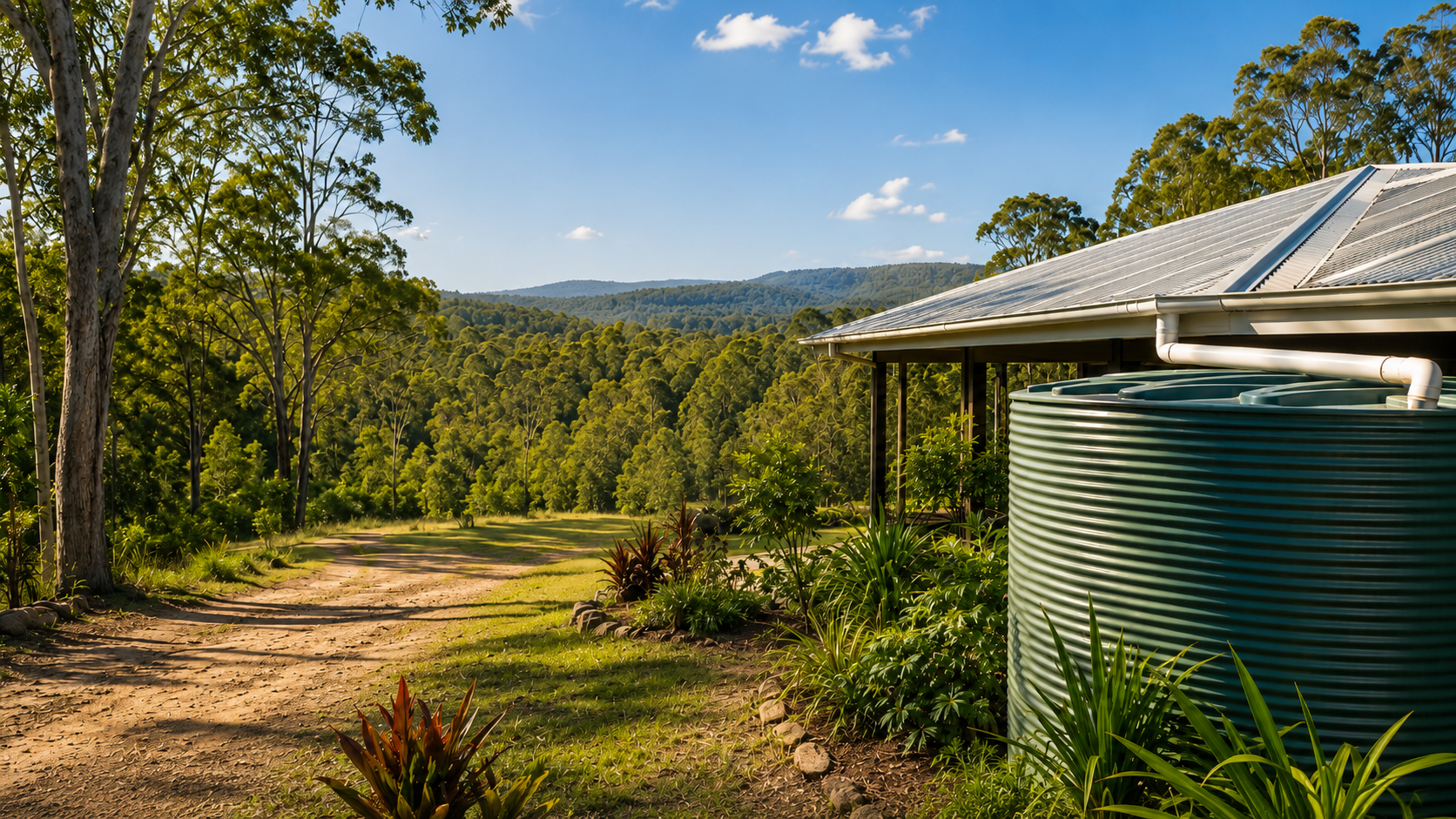
Kenilworth sits on the Mary Valley fringe of the Sunshine Coast service area — a quiet farming town surrounded by small-farm acreage, working blocks, lifestyle properties and rolling green country. Most Kenilworth properties rely on rainwater tanks for everyday household water, with bores common on long-held acreage for stock, irrigation or backup. Many Kenilworth blocks have built up their tank-and-bore plumbing over many years — heritage tanks, newer additions, stock lines, irrigation lines — and the picture can become layered and complex without a clear plan. Regular testing helps Kenilworth property owners clarify what each source is actually delivering at each point of use, and gives a documented baseline against which to track any changes over time.
Local context: Kenilworth's most commonly reported water-testing concerns relate to mixed tank-and-bore plumbing on long-held farming blocks, heritage tanks with original fittings still in place, and tank refills during long dry stretches — rather than a single obvious cause.
Likely water sources in Kenilworth
- Rainwater tanks on Kenilworth acreage, small-farm and Mary Valley fringe blocks
- Bores on long-held Kenilworth rural-acreage — often present alongside the tank
- Larger tanks where the block runs stock, irrigation or a working garden
- Multi-tank setups on long-held heritage and farming properties
Common local water concerns
- Kenilworth small-farm catchments where paddock, shed and house roofs share runoff patterns
- Mary Valley fringe bores that can vary noticeably from one property to the next
- Long-held Kenilworth heritage tanks with fittings that pre-date current household use patterns
- Tank refills via water truck during long dry stretches on farming blocks
- Stored rainwater on Kenilworth properties with seasonal occupancy
- Multi-tank Kenilworth setups where the line-of-use isn't always clearly documented
Recommended test packages for Kenilworth
Based on the typical water-supply profile and property mix in this suburb. You can also mix and match samples — e.g. one tap and one tank — on a single booking.
Sample collection & drop-off
- Use a sterile sample bottle (we supply one when you book).
- Keep your sample cool and out of direct sunlight after collection.
- Bacterial samples must reach the lab within 24 hours of collection.
- Drop-off: 1/37 Gateway Drive, Noosaville QLD 4566 — Monday to Thursday before 2 pm.
Kenilworth is approximately 45 minutes by car from our Noosaville lab at 1/37 Gateway Drive. Drop-off accepted before 2 pm Monday to Thursday — or posted samples are accepted as long as they reach us within 24 hours of collection.
Local FAQ — Kenilworth
Our Kenilworth small-farm runs stock and the house off different sources — what should we test?
Yes, ideally both sources. Rainwater tank and bore water have different risk profiles, and testing each source separately on the same visit gives you a complete picture of the property. Tank water often needs closer microbiological review, while bore water often needs closer review for hardness, conductivity, iron, manganese, pH and dissolved minerals.
Our Kenilworth tank is heritage — do older tanks always need replacement?
Not always. Heritage tanks can hold water perfectly well for many years, and a single AWARE Tank 360 is a sensible first step before any replacement decision. The plain-English report tells you whether the stored water meets typical drinking water expectations or whether cleaning, refurbishment or replacement should be considered.
Our Kenilworth tank gets topped up by a water truck during dry periods — does that affect testing?
It can. Truck-delivered water has its own chain, and mixing a load of delivered water into a tank that already had stored rainwater changes the overall chemistry. The AWARE Tank 360 gives you a clear picture of the combined load before the next dry stretch, and a baseline to compare against in future seasons.
We have several Kenilworth tanks built up over decades — where do we start?
Start with the tank that feeds the main household tap, then add any other tank where you're unsure about the line-of-use. One sample tells you about one tank's water, so testing each tank that serves a different purpose gives you a tank-by-tank picture and lets you make practical decisions about which water belongs at which outlet.
Kenilworth is on the Mary Valley fringe — does that affect our bore?
Bore water can vary from property to property, and a one-off AWARE Bore 360 gives you a documented baseline for hardness, pH, iron, manganese and conductivity. The plain-English report helps clarify whether the bore water is consistent with typical use expectations or whether further filtration, maintenance or treatment should be considered.
How long do water testing results take?
Most reports are usually returned within 1–3 days, depending on the test package, sample timing and lab workload. Bacterial tests (E. coli, coliforms) start the day your sample arrives at the lab.
What's the difference between the AWARE 4-Point and the AWARE Tank 360?
The AWARE 4-Point ($129) screens for E. coli (Positive/Negative) and Coliforms (Positive/Negative) plus pH and Conductivity — answering the question 'is my water safe to drink?'. The AWARE Tank 360 ($209) adds TDS, turbidity, alkalinity, hardness, cations, anions and metals — giving you a broader picture of your rainwater tank's water quality and overall system health.