Why water testing matters in Conondale
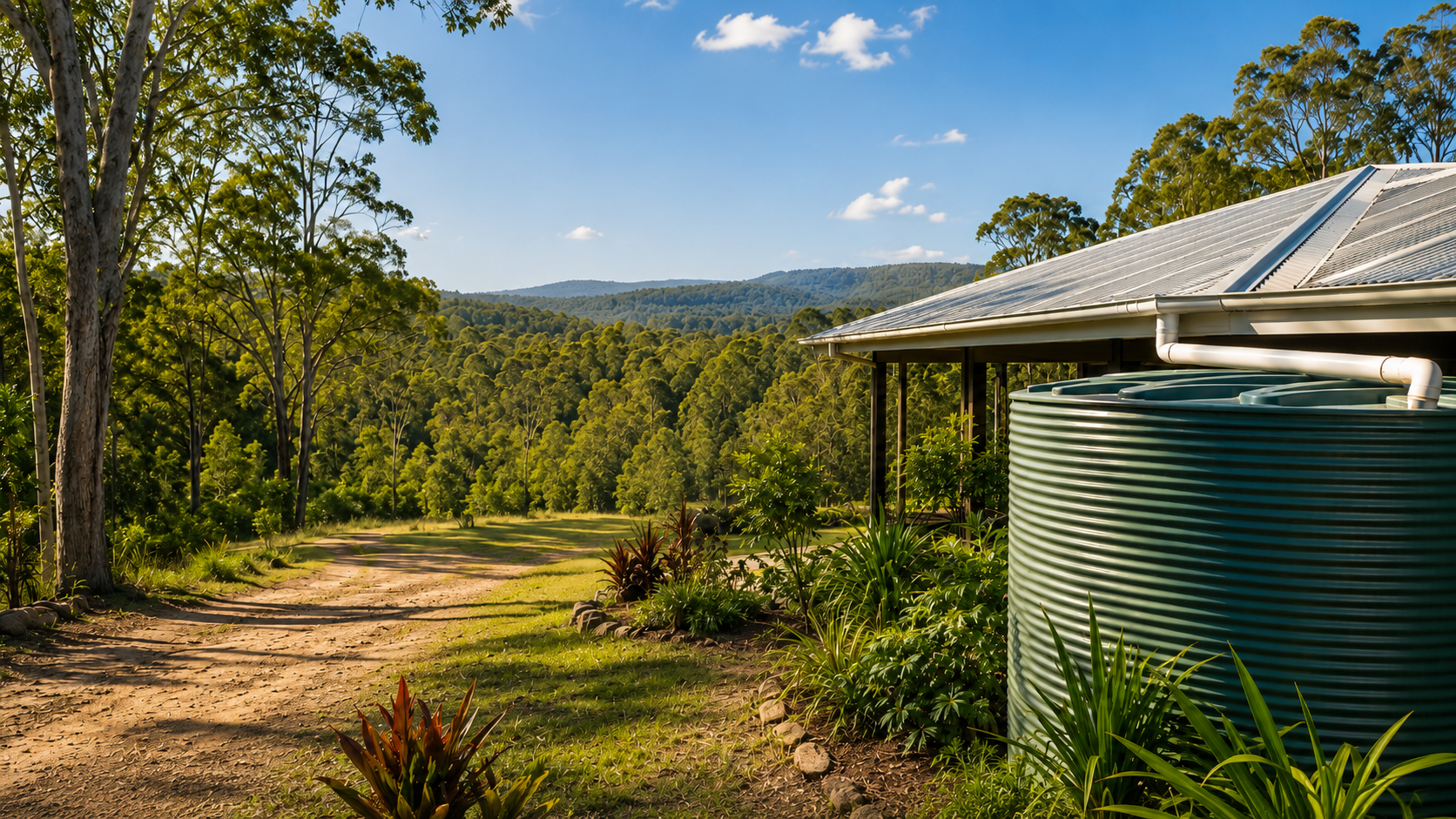
Conondale is deep bushland and acreage country — remote rural blocks, native canopy, long internal driveways and a strong tradition of self-sufficient water supply. Most Conondale properties rely on one or more rainwater tanks for drinking and household water, with bores common on long-held acreage blocks for stock, irrigation or backup. The independence is part of the appeal, but it also means there's no town network to fall back on if something goes off — and the heavy native canopy that gives Conondale its character drops a lot of organic matter onto roofs. Regular testing helps Conondale property owners stay ahead of issues like wildlife contamination, leaf litter, low pH, mineral changes or shifts after long dry stretches.
Local context: Conondale's most commonly reported water-testing concerns relate to remote bushland catchments, multi-purpose tank-and-bore plumbing on acreage blocks, and tank refills during long dry stretches — rather than a single obvious cause.
Likely water sources in Conondale
- Rainwater tanks on Conondale acreage and bushland blocks
- Bores on long-held Conondale rural-acreage — often present alongside the tank
- Multi-tank setups on remote bushland properties
- Tanks supporting stock troughs, irrigation and household use on the same block
Common local water concerns
- Conondale acreage properties where the tank is the primary household water source
- Remote bushland catchments with heavy native canopy and infrequent gutter access
- Long internal driveways and tracks that make sample-transport timing important
- Older Conondale bores serving stock, irrigation and occasional household use
- Tank refills via water truck during long dry stretches on remote blocks
- Stored rainwater on Conondale properties with seasonal or weekender occupancy
Recommended test packages for Conondale
Based on the typical water-supply profile and property mix in this suburb. You can also mix and match samples — e.g. one tap and one tank — on a single booking.
Sample collection & drop-off
- Use a sterile sample bottle (we supply one when you book).
- Keep your sample cool and out of direct sunlight after collection.
- Bacterial samples must reach the lab within 24 hours of collection.
- Drop-off: 1/37 Gateway Drive, Noosaville QLD 4566 — Monday to Thursday before 2 pm.
Conondale is approximately 1 hour 15 minutes by car from our Noosaville lab at 1/37 Gateway Drive. Drop-off accepted before 2 pm Monday to Thursday — or posted samples are accepted as long as they reach us within 24 hours of collection.
Local FAQ — Conondale
Our Conondale tank is the only household water source — what's the practical testing routine?
For properties where the tank is the sole household water source, an annual AWARE Tank 360 is a sensible baseline, and additionally after any major trigger event — a roof clean, a heavy storm, dead wildlife found in the tank, a taste or odour change, or any household illness with no other obvious cause.
Our Conondale tank was just refilled by a water truck — should we test before drinking?
It's often worth checking. Truck-delivered water has its own chain — the source, the truck's storage condition, and how recently the truck was used for other purposes all matter. Mixing a load of delivered water into a tank that already had stored rainwater changes the overall chemistry, and the AWARE Tank 360 gives you a clear picture of the combined load.
We have a Conondale bore that's been used for stock for years — does it need testing?
It's often worth checking at least once for any working stock bore. Bore water that's been fine for stock for years can still drift as the bore ages, and a single test gives you a documented baseline. If something changes later — taste, smell, staining or pump performance — you have a clean comparison point rather than guesswork.
Conondale is a long drive — can we post samples instead?
Yes. We accept posted samples as long as they reach us within 24 hours of collection — that 24-hour window is the binding constraint for bacterial accuracy. We supply sterile sample bottles and a step-by-step collection guide when you book, and most posted samples from Conondale reach our Noosaville lab within standard Australia Post timeframes.
Our Conondale property is remote and the tank sits under heavy bushland canopy — what's likely to come up in a test?
Native canopy catchments can vary from property to property, and the indicators most worth checking are usually microbiological screening, pH, conductivity and the broader chemistry panel. The AWARE Tank 360 report gives you a plain-English picture of what's actually in your stored water rather than relying on assumption.
How long do water testing results take?
Most reports are usually returned within 1–3 days, depending on the test package, sample timing and lab workload. Bacterial tests (E. coli, coliforms) start the day your sample arrives at the lab.
What's the difference between the AWARE 4-Point and the AWARE Tank 360?
The AWARE 4-Point ($129) screens for E. coli (Positive/Negative) and Coliforms (Positive/Negative) plus pH and Conductivity — answering the question 'is my water safe to drink?'. The AWARE Tank 360 ($209) adds TDS, turbidity, alkalinity, hardness, cations, anions and metals — giving you a broader picture of your rainwater tank's water quality and overall system health.