
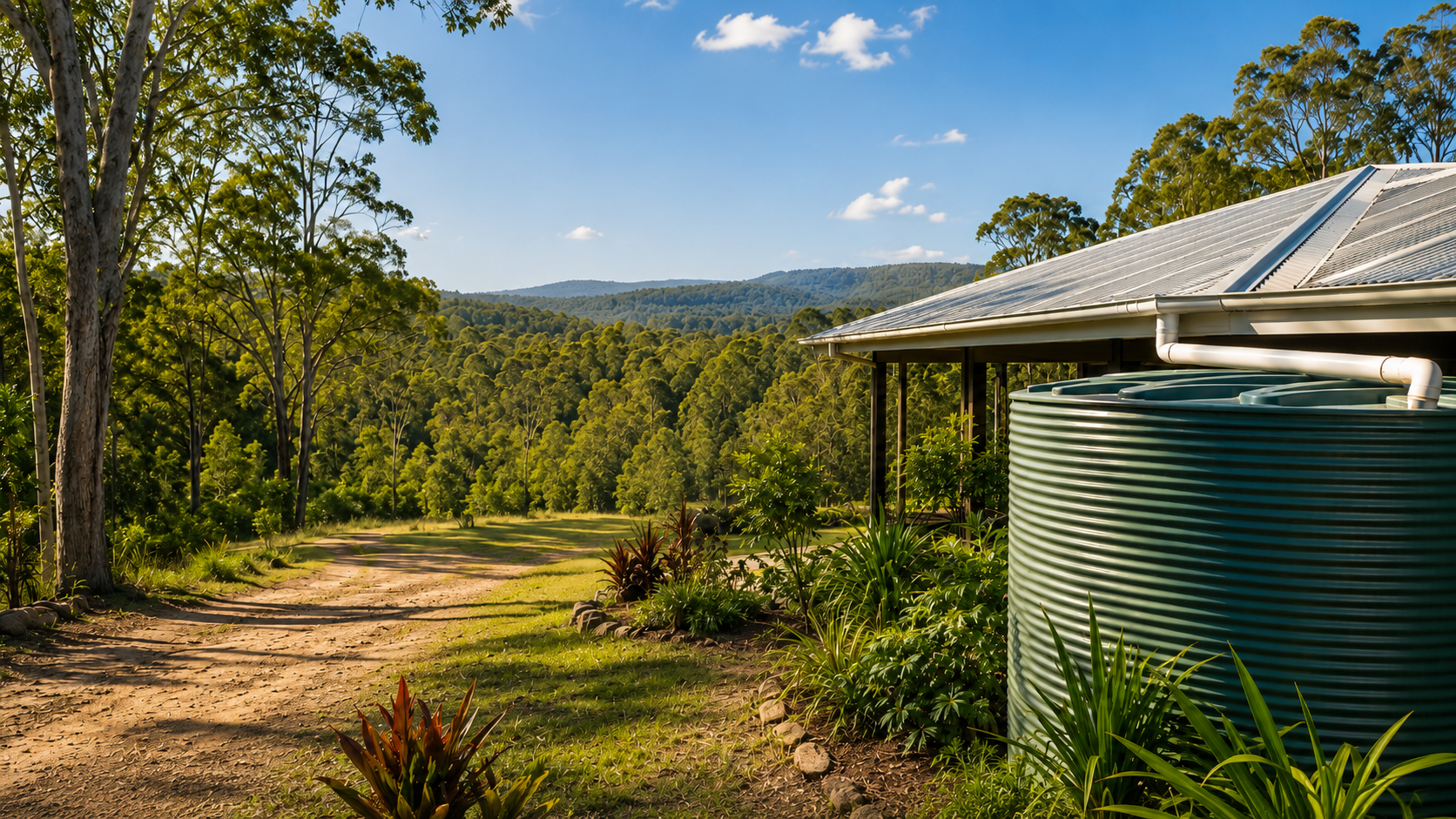
Why water testing matters in Buderim
Buderim sits on a distinctive ridge — established streets, mature gardens, and a mix of long-held heritage homes alongside newer family builds on bigger blocks. Many Buderim homes use rainwater tanks alongside their main household supply — typically used for garden taps, laundry lines, pool top-ups, and occasional household supply on larger blocks where the tank capacity supports it. The water in those tanks can vary noticeably from one Buderim property to the next, depending on roof material, gutter maintenance, how often the tank is used, and whether the plumbing has been touched during renovations. Regular testing helps clarify what's actually coming out of each tank-fed outlet rather than relying on assumption.
Local context: Buderim's most commonly reported tank-water concerns relate to low-use garden and pool top-up lines, older fittings on long-established homes, and uncertainty around which outlets are tank-fed on renovated properties — not the town supply itself.
Likely water sources in Buderim
- Rainwater tanks on Buderim Mountain–side blocks for garden, laundry and pool top-up
- Older Buderim heritage homes with tank-fed outdoor outlets
- Mixed tank / town plumbing on larger family blocks
- Occasional older bores on long-held properties — uncommon but worth checking when present
Common local water concerns
- Tank-fed garden and pool top-up lines that sit unused through cooler months
- Long-established Buderim heritage homes with original fittings still in place
- Larger sloping blocks where the tank, pump and outlets sit some distance apart
- Roof catchments under mature street and garden canopy collecting more leaf debris than newer estates
- Stored rainwater on properties that switch between mains and tank seasonally
- Uncertainty about which outlets are tank-fed versus mains-fed on renovated Buderim homes
Recommended test packages for Buderim
Based on the typical water-supply profile and property mix in this suburb. You can also mix and match samples — e.g. one tap and one tank — on a single booking.
Sample collection & drop-off
- Use a sterile sample bottle (we supply one when you book).
- Keep your sample cool and out of direct sunlight after collection.
- Bacterial samples must reach the lab within 24 hours of collection.
- Drop-off: 1/37 Gateway Drive, Noosaville QLD 4566 — Monday to Thursday before 2 pm.
Buderim is approximately 25 minutes by car from our Noosaville lab at 1/37 Gateway Drive. Drop-off accepted before 2 pm Monday to Thursday — or posted samples are accepted as long as they reach us within 24 hours of collection.
Local FAQ — Buderim
Our Buderim tank feeds the pool top-up and the garden — does that need testing?
It's often worth checking, even when no-one drinks directly from those outlets. Pool top-up water can affect chemistry balance over time, and garden taps are commonly used by kids and visitors for a casual drink. The AWARE Tank 360 gives you a clear plain-English picture of the stored water so you can decide whether the tank is fine as-is, would benefit from a clean, or should be taken offline for that purpose.
We've just renovated a Buderim home — should we test the tank water before using it again?
Yes — renovations frequently move plumbing in ways that aren't obvious afterwards, and a tank that hasn't been used during the build can pick up sediment or microbiological changes while it sits. A test once the new plumbing is in helps clarify which outlets the tank is actually feeding now, and confirms the stored water is in good condition before everyday use resumes.
Our Buderim block has a big mature garden — does the heavy canopy affect the tank?
Mature gardens often mean noticeably more leaf litter on the roof than in newer estates, which can affect both the catchment quality and the rate at which the tank gradually accumulates organic matter. Gutter clearing and a well-maintained first-flush diverter make the biggest practical difference. Annual testing helps you see whether the catchment is keeping up or whether the tank itself is starting to need attention.
How often should we test a Buderim tank that's only used for laundry and garden?
Annual testing is a sensible baseline even for tanks that aren't on a drinking line. The AWARE Tank 360 gives you a documented picture year on year, which is useful when something does change — taste, smell, staining — because you have a clean comparison point rather than guesswork.
We're unsure whether a particular Buderim tap is tank-fed or mains-fed — can a test tell us?
Testing samples from each outlet you're unsure about is one of the cleanest ways to find out. Different water sources often show different chemistry, so the report from two samples will usually make the source plumbing obvious — and gives you a basis for a sensible plumbing trace if needed.
How long do water testing results take?
Most reports are usually returned within 1–3 days, depending on the test package, sample timing and lab workload. Bacterial tests (E. coli, coliforms) start the day your sample arrives at the lab.
What's the difference between the AWARE 4-Point and the AWARE Tank 360?
The AWARE 4-Point ($129) screens for E. coli (Positive/Negative) and Coliforms (Positive/Negative) plus pH and Conductivity — answering the question 'is my water safe to drink?'. The AWARE Tank 360 ($209) adds TDS, turbidity, alkalinity, hardness, cations, anions and metals — giving you a broader picture of your rainwater tank's water quality and overall system health.