What if a "failed" water analysis was actually the best news you've received about your property this year? Opening a lab report to find technical jargon and numbers outside the preferred range is enough to make any Australian homeowner feel uneasy. You might worry about the health of your family or the long-term impact on your household appliances. Understanding exactly what to do after a bad water test result is the first step toward regaining your peace of mind. Instead of a reason to panic, these results act as a diagnostic tool that tells you exactly where to look for a specific environmental or maintenance issue.
We agree that deciphering a Certificate of Analysis shouldn't require a science degree. This guide provides a practical, step-by-step roadmap to help you navigate results that do not meet the Australian Drinking Water Guidelines. You'll learn how to distinguish between aesthetic concerns like iron staining and health-based guidelines such as E. coli detections. We'll show you how to identify the source of the issue and explain why choosing a treatment option should only happen once you have a clear picture of your water's chemistry. This approach ensures you spend money on solutions only when they're truly necessary.
Key Takeaways
- Distinguish between "Health" and "Aesthetic" guideline values to understand whether your water quality impacts your household plumbing or requires more immediate attention.
- Identify common parameters that may be outside the preferred range, including pH levels, water hardness, and microbiological indicators like E. coli.
- Learn exactly what to do after a bad water test result, including immediate precautions for food preparation and how to physically inspect your water source.
- Investigate potential contamination sources by looking at environmental factors like surface runoff and infrastructure issues such as old galvanised pipes.
- Understand the importance of professional laboratory analysis as a baseline before committing to any specific water treatment or filtration solution.
Table of Contents
Understanding Your Report and the Australian Drinking Water Guidelines
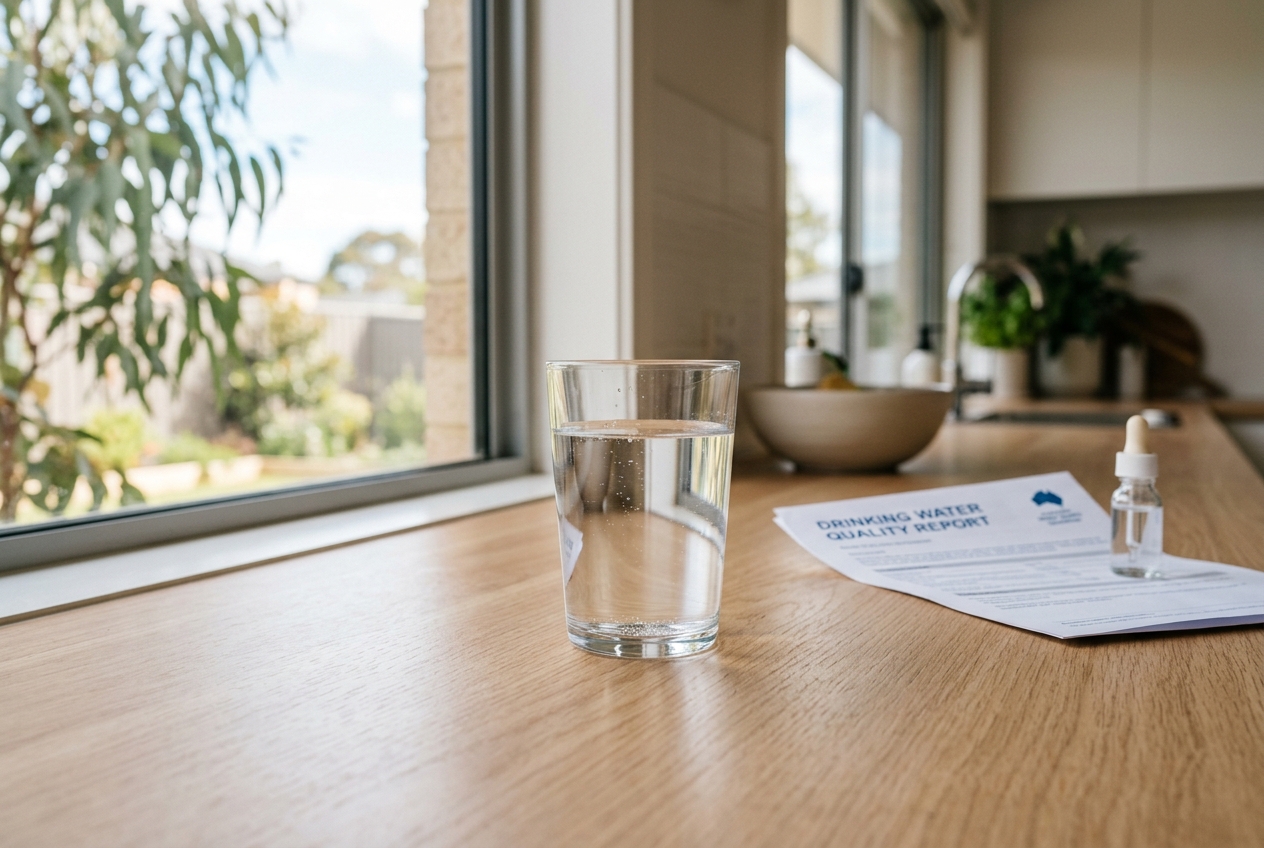
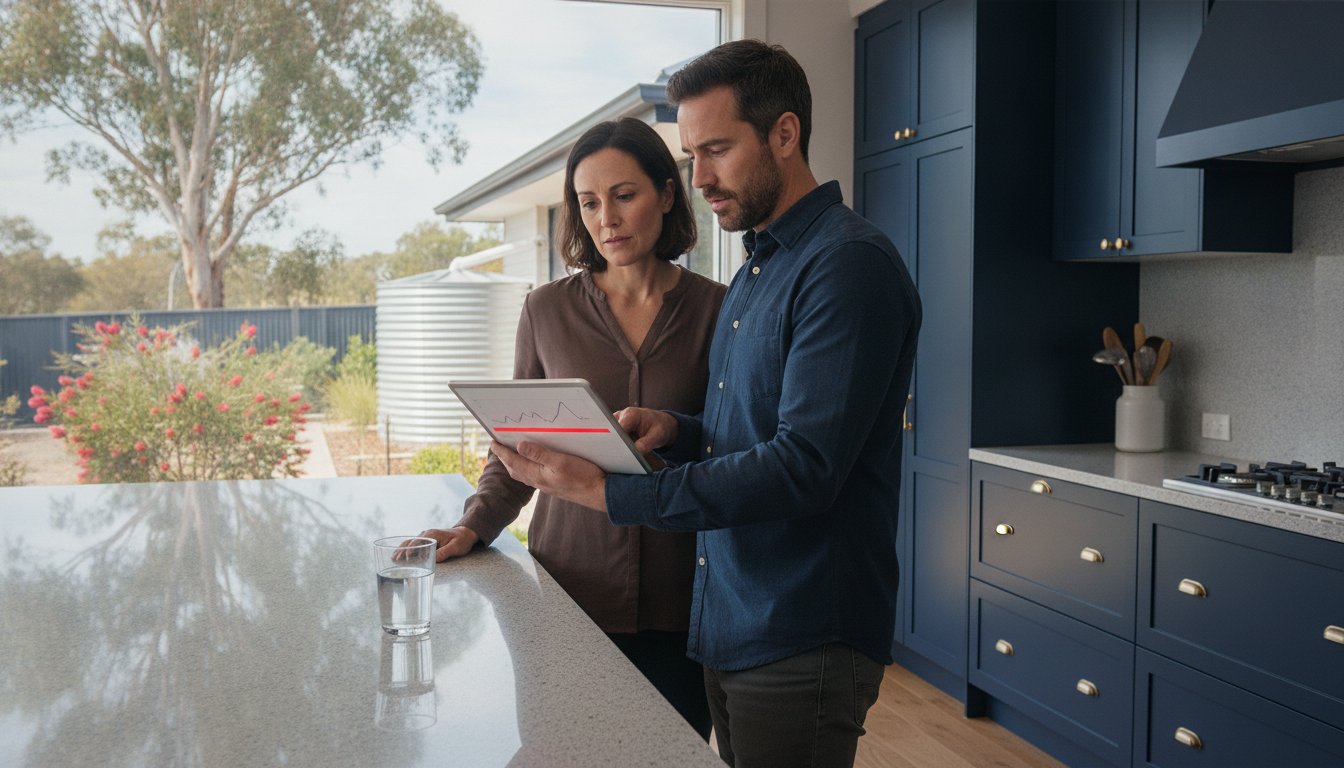
Understanding what to do after a bad water test result begins with your lab report. Your Certificate of Analysis (COA) might look like a wall of data, but it's actually a roadmap for your property's water quality. The Australian Drinking Water Guidelines (ADWG) provide the benchmarks used by laboratories to assess your water. These guidelines aren't just a pass or fail test. They're a framework designed to help you manage your water supply effectively. Seeing a number in red or bold can be startling, but it's often just an indicator that a specific part of your water system needs attention.
You'll usually see two types of units on your report. Chemical concentrations are measured in milligrams per litre (mg/L). For context, 1 mg/L is roughly equivalent to one minute in two years. Microbiological results use Colony Forming Units (CFU) or Most Probable Number (MPN) per 100mL. For bacteria like E. coli, the guideline is clear: it should not be detected in any 100mL sample. If it is detected, the sample does not meet the Australian Drinking Water Guidelines and the issue should be addressed.
Health vs Aesthetic Guideline Values
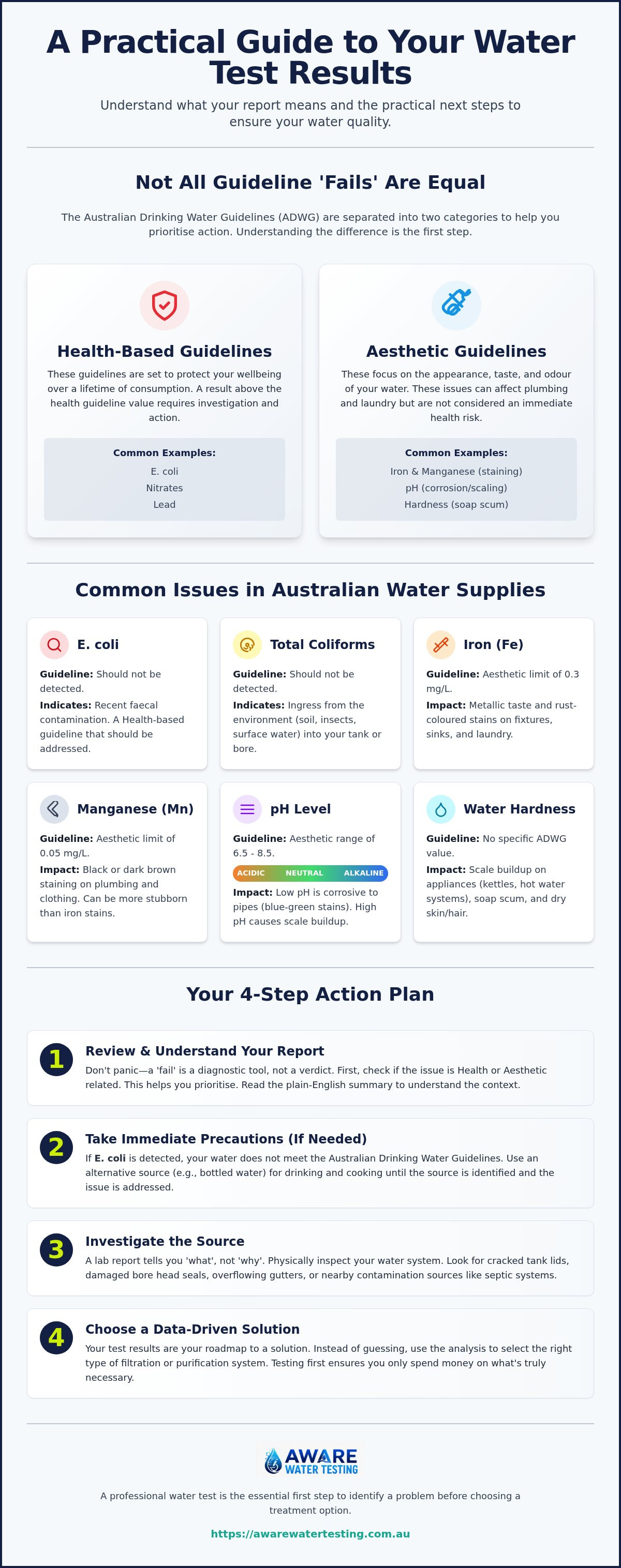
The ADWG separates parameters into two distinct categories. Health-based guidelines, such as those for E. coli, nitrates, or lead, are set to protect your wellbeing over a lifetime of consumption. If a result is above the health guideline value, it requires investigation and action. Aesthetic guidelines focus on the appearance, taste, and odour of your water. This includes pH, hardness, iron, and manganese. For example, the aesthetic guideline for iron is 0.3 mg/L. If your result is 0.5 mg/L, your water might taste metallic or stain your laundry, but it doesn't trigger the same immediate health response as a bacterial detection. Distinguishing between these two categories helps you prioritise your next steps.
Standard Terminology You Will See
Your report will often mention the "Limit of Reporting" (LOR). This is simply the lowest level the lab's instruments can reliably detect. If a result is listed as "< LOR", it means the substance wasn't found at a detectable level. When a result is described as "outside the preferred range", it's a prompt to look at your infrastructure. Perhaps your rainwater tank needs a clean or your bore head isn't sealed correctly. AWARE Water Testing provides a plain-English summary with every report, which is a practical first step in deciding what to do after a bad water test result without needing a background in chemistry.
Common Parameters That May Be Above the Guideline Value
Many homeowners find that their results are outside the preferred range for a few specific parameters. This is common across Australia, from rural bores to coastal rainwater tanks. Understanding these values is the key to knowing what to do after a bad water test result. The Australian Drinking Water Guidelines provide specific thresholds for both health and aesthetic reasons.
Bacteria and Microbiological Results
A microbiological analysis often looks for two main indicators — our guide to coliform in your water covers both. Coliforms are a broad group of bacteria found in the environment. While they don't always indicate faecal contamination, a sudden increase suggests that surface water or insects might be entering your tank or bore. This is an indicator of environmental ingress that needs investigation.
E. coli is a more specific marker. Its presence indicates recent faecal contamination from warm-blooded animals. The health-based guideline states that E. coli should not be detected in a 100mL sample. If your report shows a detection, the sample does not meet the Australian Drinking Water Guidelines and the issue should be addressed. This helps clarify what to do after a bad water test result without the need for guesswork. Often, this involves checking the integrity of your tank lid or the seal on your bore head.
Metals and Mineral Content
Metallic elements often impact the "aesthetic" quality of your water. Iron and manganese are common in Australian groundwater. If iron levels are above the guideline value of 0.3 mg/L, you might notice a rust-brown colour or a metallic taste. Manganese has a health-based guideline of 0.1 mg/L, but its aesthetic limit is lower at 0.05 mg/L to prevent black staining on laundry and plumbing fixtures.
- Hardness: The aesthetic guideline is 200 mg/L. High hardness causes scale build-up in pipes and can shorten the life of hot water systems.
- pH levels: The preferred range is 6.5 to 8.5. Water outside this range can be corrosive to metal pipes or cause encrustation.
- Lead: While the source water is often clear, lead can enter the supply through old galvanised pipes or lead-based solder in household plumbing.
- Salinity (TDS): Total Dissolved Solids tell you the concentration of dissolved substances. High salinity can affect taste and appliance performance.
Nitrates are another consideration, particularly in agricultural areas. The health-based guideline is 50 mg/L to protect bottle-fed infants. Understanding these specific numbers helps you move from confusion to a clear plan of action. If you're ready to get a professional baseline, you can book a comprehensive analysis to see exactly where your water sits against these standards.
Immediate Steps for Tank, Bore, and Mains Water
Receiving a report that shows your supply does not meet the Australian Drinking Water Guidelines is a prompt for action, not alarm. Your first priority is to manage how the water is used within the home while you investigate the cause. As a precaution, you should stop using the water for drinking, brushing teeth, or food preparation. It's best to rely on an alternative supply, such as bottled water or a known treated source, until the issue is addressed. Make sure to communicate these results clearly with everyone in your household so they're aware of the temporary changes.
A critical part of knowing what to do after a bad water test result is reviewing the plain-English summary provided with your analysis. This document translates the lab data into practical insights, helping you decide which areas of your property to inspect first. For additional context, you can also refer to the NSW Health advice on drinking water, which outlines how to handle specific contamination issues. A physical check of your water source is often the next logical step. Start by ensuring your tank lid is secure or that your bore head is properly sealed against surface water ingress.
For Rainwater Tank Owners
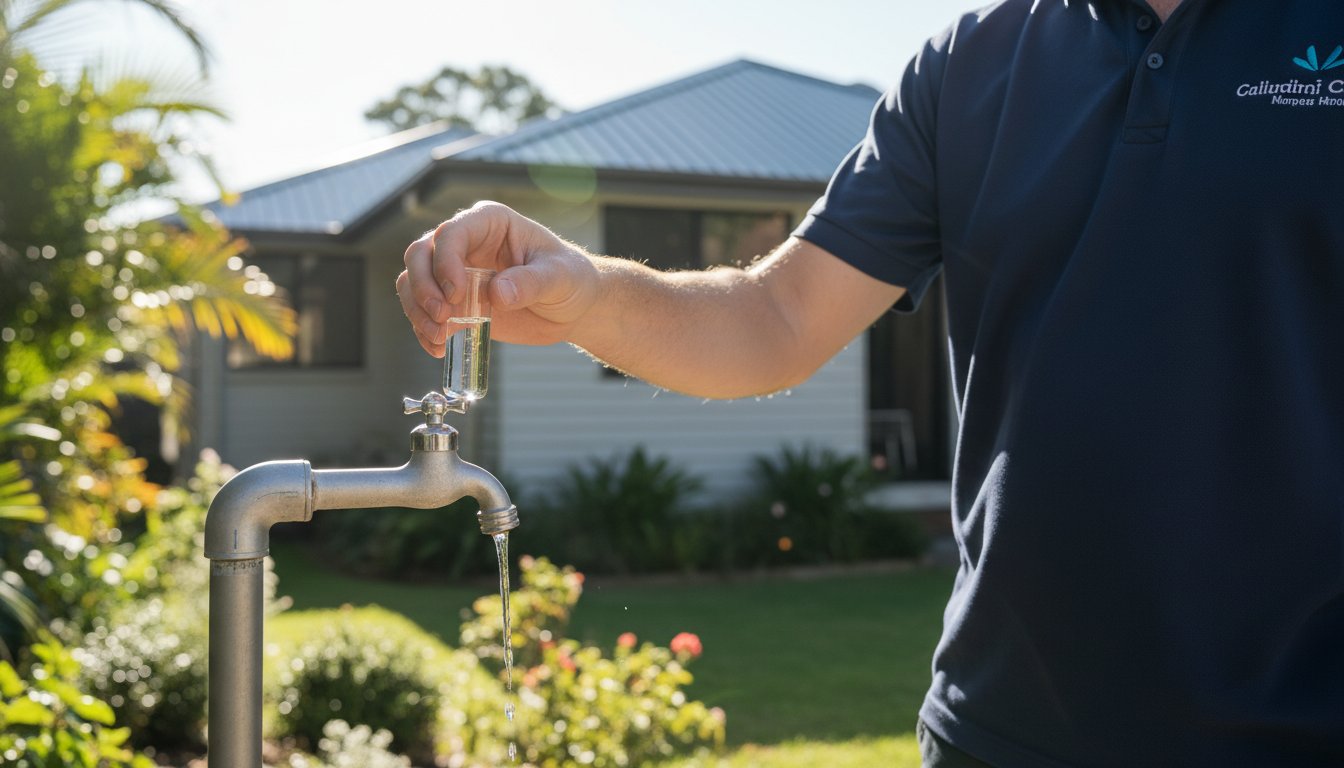
If your rainwater analysis shows results outside the preferred range, start your investigation at the roof. Inspect your gutters for leaf litter, bird droppings, or stagnant water that can lead to bacterial growth. Ensure your first-flush diverters are functioning correctly and haven't become blocked over time. Inside the tank, look for signs of animal ingress or a build-up of sediment at the base. Often, a professional Rainwater Tank Testing is the most efficient way to confirm if a maintenance issue is the root cause of the problem.
For Bore Water Users
Bore water quality can shift due to environmental changes or infrastructure wear. Inspect the bore casing for cracks and ensure the surrounding ground slopes away from the bore head to prevent surface water runoff from entering the aquifer. Recent heavy rain or flooding can also temporarily impact groundwater chemistry, causing parameters to spike. Understanding a Bore Water Quality Assessment is essential here, as it helps you distinguish between water that is suitable for irrigation and water intended for domestic use. If you're managing a private supply, consult the Australian Drinking Water Guidelines for Private Sources to better understand your specific management responsibilities.
Investigating the Source of the Contamination
Determining exactly what to do after a bad water test result involves looking beyond the lab report to the physical environment of your property. In many parts of Australia, high mineral content in bore water is simply a result of natural geology. Elements like iron and manganese are often present in the aquifer itself, meaning the "bad" result is a characteristic of the source rather than a sign of recent pollution. However, if your report shows elevated levels of nitrates or bacteria, the cause is often closer to the surface. Agricultural activity, such as fertiliser use or livestock grazing near a bore head, can cause nutrients to leach into the groundwater over time.
Infrastructure and maintenance gaps are equally common culprits. Sediment build-up at the bottom of a rainwater tank can harbour bacteria and affect the clarity of your water. If you use a UV purification system, it's vital to remember that these units require regular servicing to remain effective. High turbidity can shield bacteria from UV light by providing tiny physical barriers that prevent the light from reaching and neutralising the organisms. This is why a result outside the preferred range for turbidity often goes hand-in-hand with a positive bacteria detection.
Is the Problem in the Source or the Plumbing?
A common point of confusion for homeowners is whether a contaminant like lead or copper is in the water source or leaching from the household pipes. You can isolate this issue by using the "First Draw" versus "Flushed" sampling technique. A first-draw sample is taken from the tap after the water has sat in the pipes overnight. If this sample shows high metal levels but a second sample taken after running the tap for two minutes is clear, the issue is likely your internal plumbing or old lead-based solder. This distinction is a vital part of knowing what to do after a bad water test result, as it prevents you from installing expensive filtration for a problem that could be managed by replacing a few metres of pipework.
Maintenance and Environmental Triggers
Environmental factors can change your water quality overnight. A cracked rainwater tank lid or a perished seal on a bore casing provides an entry point for insects, frogs, or surface water runoff. If your property uses a septic system, ensuring it is positioned a sufficient distance from your bore is critical to preventing cross-contamination. Regular physical inspections of your infrastructure can often reveal the simple reason why a sample does not meet the Australian Drinking Water Guidelines. Identifying these triggers early allows you to address the root cause rather than just treating the symptoms.
Choosing the Right Path Forward with AWARE Water Testing
Deciding what to do after a bad water test result shouldn't involve a high-pressure sales pitch. Many homeowners feel an immediate urge to install expensive filtration systems the moment a report shows a parameter is outside the preferred range. However, the most cost-effective approach is to test before you treat. A Standard Water Test acts as your diagnostic baseline. It tells you exactly what is happening in your water so you don't spend money on equipment you don't actually need. By identifying whether an issue is aesthetic or health-based, you can target your response precisely.
Why Unbiased Lab Results Matter
Getting your results from an independent laboratory is essential for transparency. If a company sells both the test and the filter, there's a risk the advice might be geared toward a sale. AWARE Water Testing doesn't sell plumbing or filtration services, so our recommendations are entirely unbiased. Our plain-English summaries are designed to empower you with facts rather than fear. We believe that once you understand your water's chemistry, you're in the best position to find a qualified professional for filtration or UV advice if the results show that treatment is truly necessary. This independence ensures that your household safety remains the only priority.
Next Steps and Peace of Mind
If your investigation revealed a clear maintenance gap, such as a dirty tank or a poorly sealed bore head, the first step is to fix the physical issue. Once you've cleaned the tank or repaired the infrastructure, we recommend organising a follow-up test. This confirms that the maintenance worked and that your water quality has returned to the expected standards. It's much cheaper to clean a tank than to install a filtration system to treat water that shouldn't have been contaminated in the first place.
Establishing a regular testing schedule every 6 to 12 months is a practical way to stay ahead of environmental changes. Water quality isn't permanent; it can shift with the seasons or local land use. If you have received a report and need a professional water analysis, we are here to help. AWARE Water Testing helps Australian households understand what is actually in their tank, bore or drinking water before choosing a treatment option. Knowing exactly what to do after a bad water test result starts with accurate, independent data and a clear plan of action.
Securing Your Property's Water Future
Knowing what to do after a bad water test result means moving from uncertainty to a clear, logical plan of action. Most results that do not meet the Australian Drinking Water Guidelines are diagnostic tools rather than reasons for panic. By distinguishing between health-based guidelines and aesthetic concerns, you can prioritise essential maintenance without overspending on unnecessary filtration systems. Whether it's a simple tank clean or a plumbing repair, the right data ensures you address the root cause effectively.
AWARE Water Testing provides expert laboratory analysis and a plain-English summary to help you make these decisions with confidence. Our national service is dedicated to giving Australian homeowners the clarity they need to manage their private water sources. Reliable information is the foundation of a safe household, and understanding your water's chemistry is the first step toward long-term peace of mind.
You don't have to navigate technical reports alone. With a professional baseline and a straightforward summary in hand, you'll have the confidence to choose the right path forward for your family and your home.
Frequently Asked Questions
Can I still drink the water if it does not meet the Australian Drinking Water Guidelines?
You should stop drinking the water as a precaution if your results do not meet health-based guidelines. Use an alternative supply, such as bottled water, for drinking and food preparation until you've identified and fixed the root cause. This is a critical part of what to do after a bad water test result. The priority is to ensure you aren't consuming water that is outside the preferred range for health parameters.
Does a "bad" result mean my water is dangerous to my health?
Not necessarily, as many results fall into "aesthetic" categories rather than health ones. A result that does not meet the Australian Drinking Water Guidelines for iron or hardness affects taste, odour, or plumbing but doesn't trigger an immediate health response. However, if health-based guidelines for E. coli or nitrates are exceeded, the issue should be addressed promptly. A professional lab report helps you distinguish between these two distinct categories.
What is the first thing I should do if E. coli is detected in my tank water?
You should immediately stop using the water for drinking or brushing teeth. Check the physical state of your tank, looking for animal ingress, a cracked lid, or leaf litter in the gutters. The presence of E. coli means the sample does not meet guidelines and the issue should be addressed. Boiling water intended for consumption is a common short-term measure while you organise a professional tank clean or maintenance check.
My water looks clear and smells fine, why did it fail the test?
Many contaminants, such as E. coli, nitrates, or lead, are tasteless, odourless, and invisible to the naked eye. While aesthetic issues like iron or manganese are easy to spot due to staining or metallic flavours, health-based parameters require laboratory analysis to detect. This is why professional testing is the only way to know what is actually in your water, regardless of how clear or clean it appears in a glass.
Should I buy a filtration system immediately after a bad test result?
You should avoid buying expensive treatment systems until you've investigated the source of the problem. Often, a "bad" result is caused by a maintenance gap, such as a dirty tank or a perished bore seal, which is cheaper to fix than installing a filter. Understanding what to do after a bad water test result starts with "testing before treating" to ensure you don't waste money on equipment that doesn't target the specific issue.
How much does it cost to fix a water contamination issue?
The cost varies significantly depending on whether the solution involves simple maintenance or complex treatment. Cleaning a rainwater tank or repairing a bore head casing is often a low-cost first step that can resolve bacterial detections. If the issue is natural groundwater chemistry, such as high salinity or hardness, a professional filtration system may be required. Always re-test after performing maintenance to confirm the water quality has returned to the preferred range.
What is the difference between health and aesthetic guideline values?
Health-based guidelines are set to protect your wellbeing from substances like E. coli or lead over a lifetime of consumption. Aesthetic guidelines relate to the "palatability" of the water, including its taste, odour, and colour. For example, high iron levels might stain your laundry and taste metallic, but they don't pose the same direct risk as a bacterial detection. Your plain-English summary will clearly separate these two types of results for you.
How often should I re-test my water after a poor result?
You should re-test your water immediately after performing any maintenance or installing a new treatment system. This confirms the issue has been resolved and the water now aligns with the Australian Drinking Water Guidelines. Once your results are back within the preferred range, establishing a regular testing schedule every 6 to 12 months is a practical way to monitor for environmental changes, heavy rainfall impacts, or infrastructure wear and tear.

Article by
Stephen McDougall
Stephen McDougall is the owner of AWARE Water Testing and Pristine Water Systems Sunshine Coast, with extensive experience in water quality, rainwater tanks, bore water, filtration and household water systems. Through AWARE Water Testing, he helps clients understand their laboratory results in clear, practical terms. Through Pristine Water Systems, he provides tailored solutions such as tank cleaning, filtration, UV purification and water treatment based on the issues identified. Stephen is known for straightforward advice and practical recommendations that help clients make informed decisions about their water.
Disclaimer
The information provided in this article is for general guidance only and is not a substitute for professional water testing or site-specific advice. Water quality can vary between properties. For accurate results and recommendations, we recommend professional testing and assessment.