If you rely on tank water, bore water, or even a private well, there's no council or water authority checking your supply for you. That responsibility sits with you — and understanding Australia's drinking water guidelines is the first step to knowing whether your water is safe.
This guide breaks down the NHMRC Australian Drinking Water Guidelines in plain language: what they cover, what the key parameters mean, and how to read a water quality report without needing a science degree.
What Are the Australian Drinking Water Guidelines?
The Australian Drinking Water Guidelines (ADWG) are published by the National Health and Medical Research Council (NHMRC). They set the benchmark for safe drinking water quality across Australia.
These guidelines apply to all drinking water supplies — mains, tank, bore, and private well. The difference is that mains water is monitored by your local water authority, while private supplies like rainwater tanks and bores are entirely the homeowner's responsibility. If that's you, our bore water safety guide and tank water safety guide cover what that responsibility looks like in practice.
The ADWG covers two main areas:
- Microbiological quality — bacteria and pathogens that can make you sick immediately (like E. coli and coliforms)
- Chemical and physical quality — dissolved minerals, metals, pH, and other characteristics that affect safety and taste over time
Key Parameters and What They Mean
Here are the most common things tested in a standard water quality assessment, and what the ADWG guideline values mean for you:
Microbiological
| Parameter | Guideline Value | What It Means |
|---|---|---|
| E. coli | 0 per 100mL | Any detection means faecal contamination — do not drink without treatment |
| Coliforms | 0 per 100mL | Indicates potential contamination pathway — not always dangerous, but a warning sign |
Chemical
| Parameter | Guideline Value | What It Means |
|---|---|---|
| pH | 6.5 – 8.5 | Outside this range your water may corrode pipes, taste metallic, or irritate skin — see why pH matters |
| Total Dissolved Solids (TDS) | < 600 mg/L | Higher levels affect taste; very high TDS can indicate mineral or salt contamination |
| Nitrate | < 50 mg/L | Elevated levels common in bore water near agricultural land; dangerous for infants |
| Lead | < 0.01 mg/L | Can leach from old pipes and fittings; no safe level for long-term exposure |
| Iron | < 0.3 mg/L | Causes brown staining and metallic taste; common in bore water |
| Manganese | < 0.1 mg/L | Causes black staining; health concerns at higher levels, especially for children |
| Fluoride | < 1.5 mg/L | Added to mains water but naturally present in some bores; excess can cause dental fluorosis |
| Hardness | < 200 mg/L (aesthetic) | Hard water isn't a health risk but causes scale build-up and soap issues |
Physical
| Parameter | Guideline Value | What It Means |
|---|---|---|
| Turbidity | < 5 NTU | Cloudy water can harbour bacteria and reduce disinfection effectiveness |
| Colour | < 15 HU | Discolouration may indicate organic matter, iron, or manganese |
How to Read a Water Quality Report
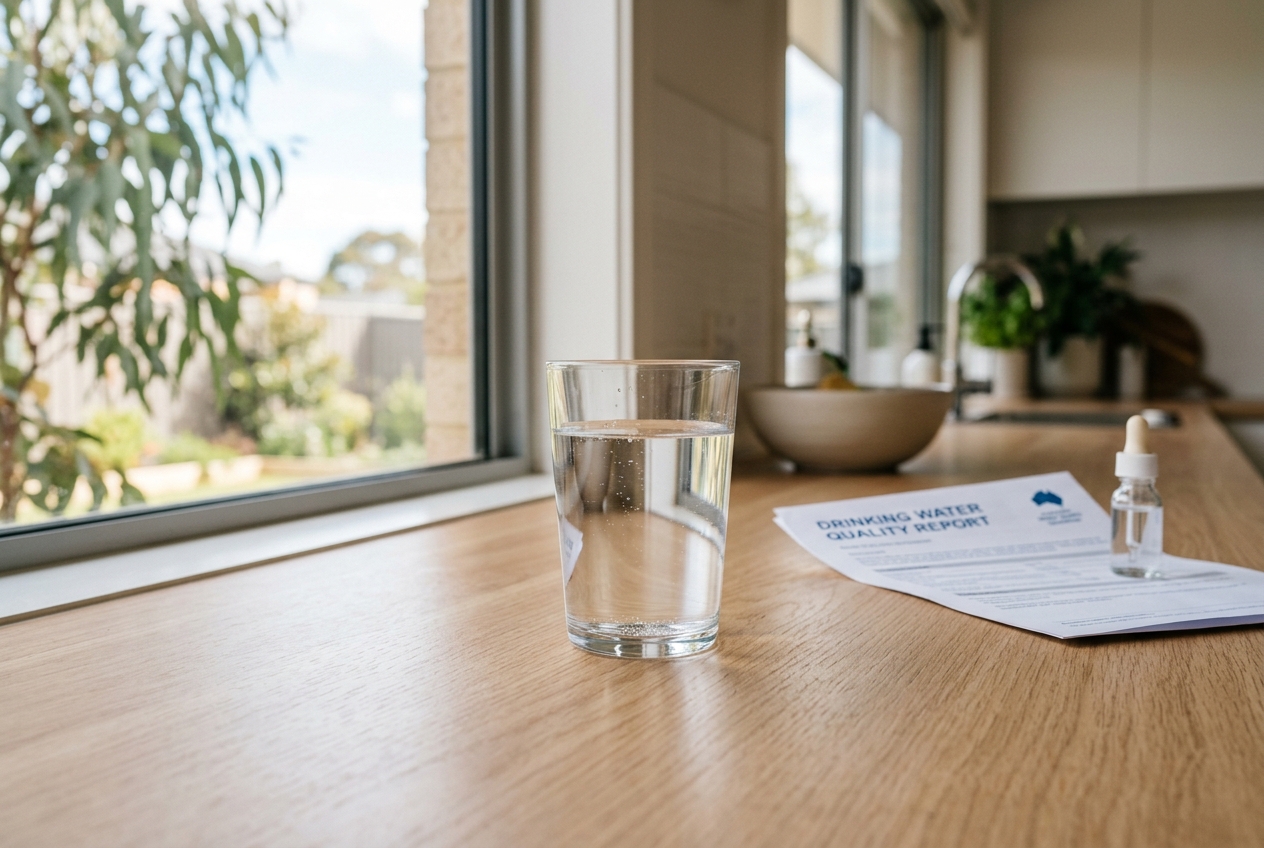
When you get results from a water testing laboratory, the report will typically show:
- The parameter name — what was tested
- Your result — the measured value in your sample
- The guideline value — the ADWG limit for safe drinking water
- Units — mg/L, NTU, pH units, CFU/100mL, etc.
The simple rule: if your result is within the guideline value, that parameter meets Australian drinking water standards. If it exceeds the guideline, it doesn't necessarily mean your water is dangerous — but it does mean further investigation or treatment may be needed.
A few things to keep in mind:
- Microbiological failures are the most urgent. If E. coli or coliforms are detected, stop drinking the water until you've identified and fixed the contamination source. See what E. coli in your water means for the step-by-step response.
- Chemical results are about long-term exposure. A single slightly elevated reading isn't an emergency, but sustained exposure matters — especially for lead, nitrate, and fluoride. Our guide to lead in drinking water explains why even low levels matter.
- Aesthetic guidelines (taste, colour, hardness) aren't health limits. Your water might taste awful but be perfectly safe, or taste fine but carry invisible risks.
- All test results relate to the sample as received by the laboratory. Results reflect a snapshot of your water at the time and place of collection.
When Should You Test Your Water?
The ADWG recommends regular testing for private water supplies. As a general guide:
- Annually — a baseline test covering microbiological and key chemical parameters
- After heavy rain or flooding — especially for tank and bore water, which are vulnerable to surface water ingress
- After any work on your system — new plumbing, pump replacement, tank cleaning, or changes to your bore
- If you notice changes — taste, colour, smell, or staining that wasn't there before
- Before buying or selling property — a water quality report gives buyers confidence and can be a condition of sale
- If anyone in the household is getting sick — unexplained gastrointestinal issues can be water-related
Who Needs Accredited Testing?
Aware Water Testing is an independent water testing laboratory providing water quality assessments for homeowners across Australia.
Where regulatory, legal, council, food production, compliance, or certification requirements apply, you should confirm whether accredited laboratory testing (NATA-accredited) is required for your specific application. Common situations that may need accredited testing include:
- Council development approvals
- Food business licensing
- Childcare or aged care facility compliance
- Legal disputes involving water quality
For general household peace of mind, an independent water test will tell you exactly what's in your water and whether it meets Australian drinking water standards.
Frequently Asked Questions
What are the Australian Drinking Water Guidelines?
The Australian Drinking Water Guidelines (ADWG) are published by the NHMRC and set the benchmark for safe drinking water quality across Australia. They cover microbiological, chemical, physical, and aesthetic parameters that determine whether water is safe to drink.
Are the ADWG legally enforceable?
The guidelines are a benchmark, not a law. However, state and territory regulators use them as the reference standard, and water authorities are expected to meet them. For private supplies like tanks and bores, the guidelines represent best practice for protecting your household's health.
How often should I test my tank or bore water?
At minimum, once a year for a standard microbiological and chemical screen. Test more frequently after heavy rain, flooding, system maintenance, or if you notice any change in taste, colour, or smell.
What should I do if my water fails a test?
It depends on what failed. Microbiological failures (E. coli, coliforms) are the most urgent — stop drinking the water and investigate the contamination source. Chemical exceedances may require treatment, filtration, or further testing to understand the trend. Your test report will help guide next steps.
Can I test my own water at home?
DIY test strips give a rough indication but lack the accuracy and range of laboratory testing. For a reliable water quality assessment that covers the parameters in the Australian Drinking Water Guidelines, laboratory analysis is recommended.
Ready to test your water?
Find out exactly what's in your tank, bore or household water — with plain-English results measured against the Australian Drinking Water Guidelines.