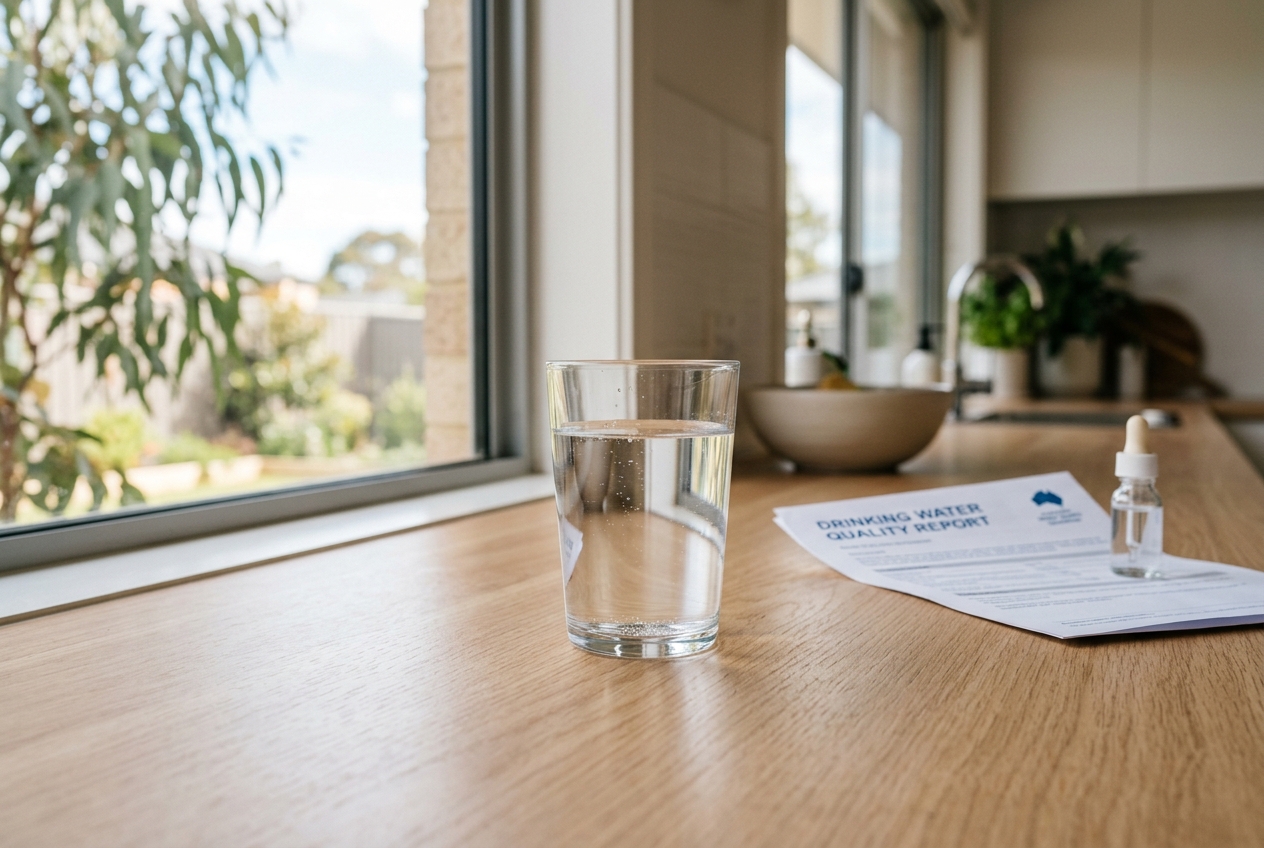
Have you ever looked at your rainwater tank after a heavy summer downpour or a nearby bushfire and wondered what exactly is settling at the bottom? It’s a common worry for the one in four Australian households that rely on harvested water, especially when technical terms like turbidity or coliforms start appearing in local news reports. You want to ensure your family’s health is protected, but the fear of choosing the wrong filtration system without any real data can be paralysing. Knowing how to get rainwater tested shouldn't feel like a chemistry assignment, yet many homeowners feel stuck between guessing their water quality and overspending on treatment.
We agree that you deserve better than guesswork when it comes to your home’s supply. This guide will show you the exact steps to professionally test your tank water, helping you understand your results against the Australian Drinking Water Guidelines (ADWG) without the stress. We’ll walk through the laboratory collection process, explain what those technical markers mean for your plumbing, and provide a clear path toward total peace of mind before you invest in any maintenance or filters.
Key Takeaways
- Learn why visual inspections can't detect invisible contaminants like heavy metals or bacteria, making professional analysis essential for tank health.
- Discover the straightforward process of how to get rainwater tested using a professional laboratory to ensure your results are accurate and reliable.
- Understand how to benchmark your water quality against the current Australian Drinking Water Guidelines (ADWG) using plain-English reports.
- See why professional testing is the necessary first step to identify specific issues before you spend money on filtration or UV systems.
- Find out how a comprehensive Rainwater Tank Health Check demystifies technical terms like turbidity and pH for the average homeowner.
Table of Contents
Understanding why rainwater testing is important for your home
Rainwater is a fantastic resource for many Australian households, providing a degree of water independence and reducing reliance on mains supplies. However, the quality of what you eventually drink or use in your laundry is a direct reflection of your home's catchment infrastructure. Every rainwater tank is part of a broader system that includes your roof, gutters, downpipes, and first-flush diverters. If any part of this system is compromised by debris, animal activity, or environmental factors, your water quality can shift quickly.
Many homeowners rely on a simple visual check, but this is often misleading. Most common contaminants, such as heavy metals or E. coli, are completely invisible and have no distinct odour or taste. Your roof itself also matters — see how roof material affects rainwater quality. Professional laboratory analysis is the only way to confirm if your water meets the Australian Drinking Water Guidelines (ADWG). If you are wondering how to get rainwater tested, the process is designed to be straightforward, providing you with a data-driven baseline before you invest in expensive filtration or UV purification systems.
The "Clear but Contaminated" myth
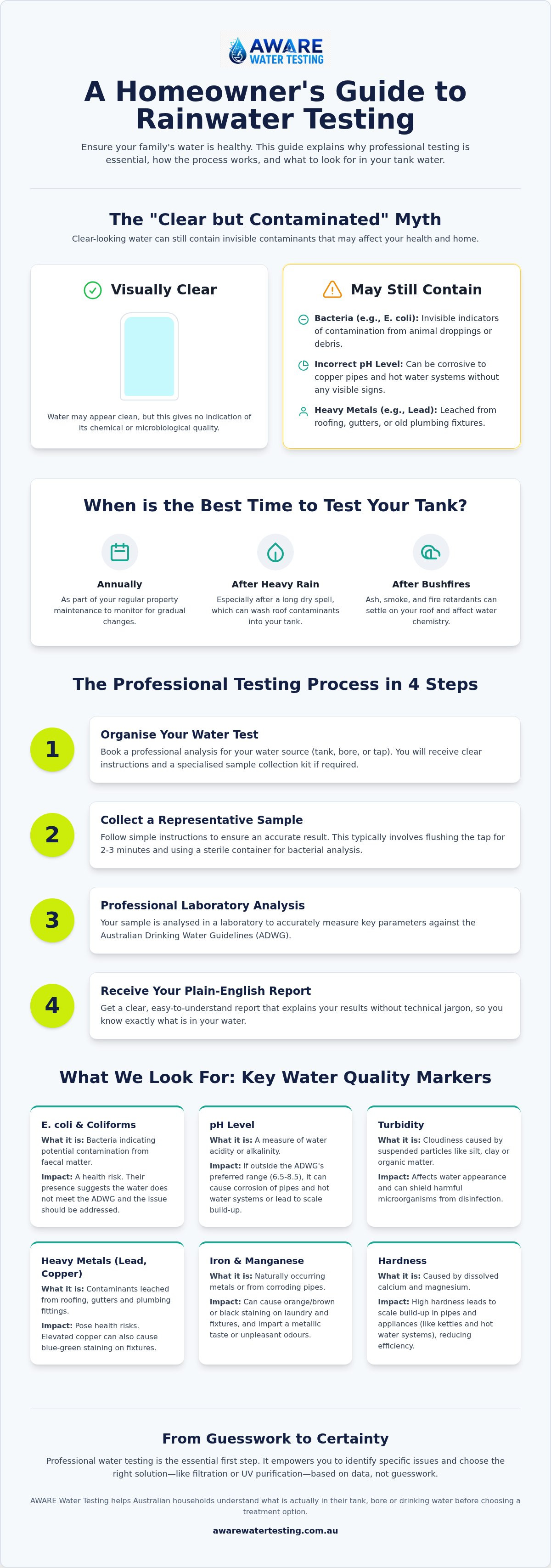
It is a common misconception that clear water is automatically healthy water. A sample might look pristine while being outside the preferred range for pH, which can lead to the corrosion of your copper pipes and hot water systems. Microbiological activity is another factor that cannot be seen with the naked eye. Utilizing professional microbiological analysis allows you to verify the biological health of your supply, ensuring that bacteria levels are identified so you can take the correct maintenance steps for your tank.
When is the best time to test your tank?
Regular analysis should be a standard part of your property maintenance schedule. We recommend an annual health check to monitor for sediment build-up or changes in chemical composition. Beyond this yearly routine, certain environmental events should trigger a fresh look at your supply. Heavy rain following a long dry spell can flush accumulated dust and bird droppings from your roof straight into the tank. Similarly, the impact of bushfires on tank water quality is a serious consideration. Even if your home was not directly in the fire zone, smoke, ash, and fire retardants can settle on your roof and affect your water's chemistry.
By understanding how to get rainwater tested, you move from guesswork to certainty. A professional report helps you identify issues like iron staining or manganese odours early, allowing you to choose a tailored solution that fits your specific results. It is the most practical first step for any homeowner concerned about their household safety.
The step-by-step process: how to get your rainwater tested
Professional water testing is far more straightforward than many homeowners realise. While DIY strips might seem convenient, they often lack the precision needed to benchmark your supply against the Australian Drinking Water Guidelines. Using a professional laboratory ensures your results are accurate and, importantly, legally defensible should you ever decide to sell your property or justify maintenance costs. If you've been wondering how to get rainwater tested without the stress of technical jargon, AWARE Water Testing has simplified the entire pathway from the initial booking to receiving your final report.
Booking your professional water analysis
The first step is to select the specific analysis required for your water source. Most homeowners start with a Standard Drinking Water Test, which covers the essential chemical and microbiological markers. Whether you rely on a tank, bore, or tap, different parameters need checking to ensure your system is functioning correctly. You can organise your professional water analysis through our online booking system. Once confirmed, you'll receive clear instructions on whether a specialised sample collection kit will be sent to you or if you can follow specific protocols for using your own clean containers.
Collecting a representative sample
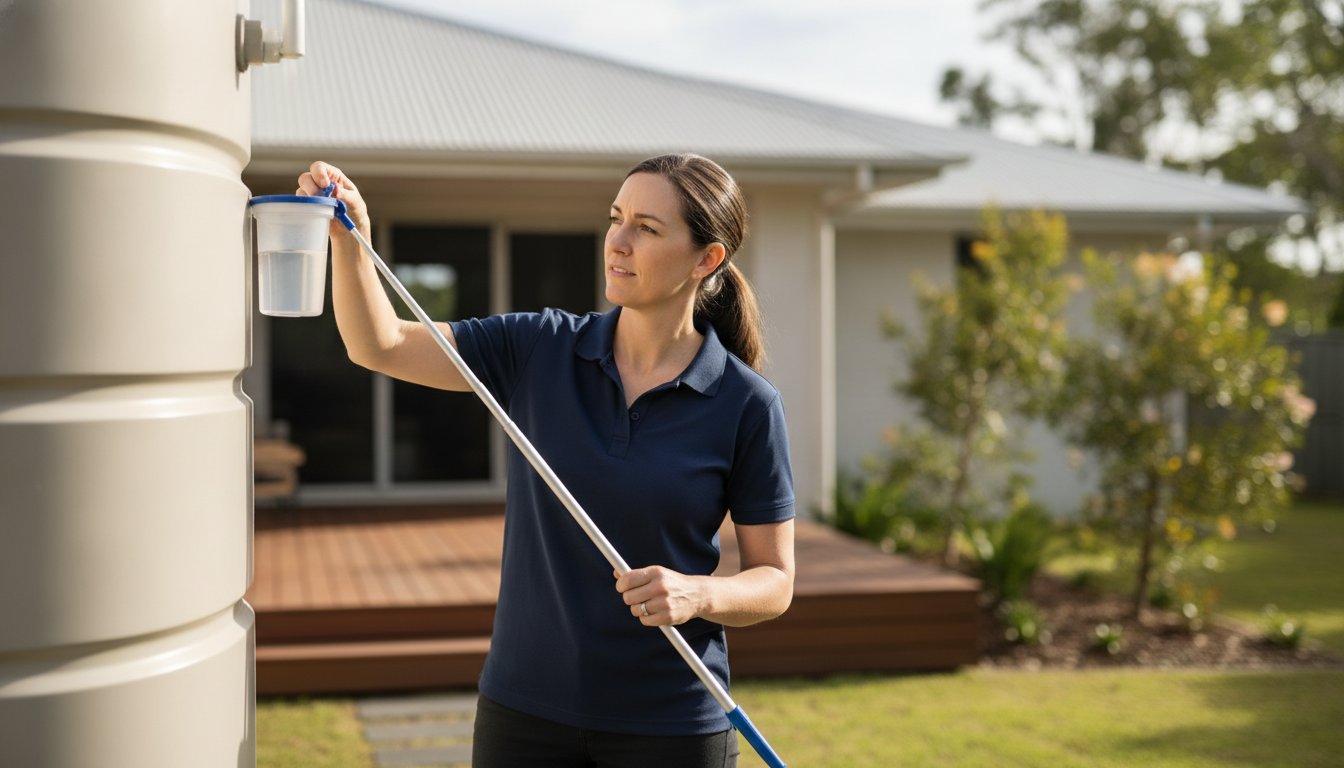
To get an accurate reading, you need a sample that represents the water you actually consume. Start by flushing the tap for at least two to three minutes. This clears out water that has been sitting in the plumbing, which might have absorbed metals from the pipes or fittings. If you are checking for bacteria, using a sterile container is vital to prevent outside contamination from skewing the results. According to the SA Health guidelines on rainwater safety, regular testing is a key part of managing a domestic supply. Once collected, label the bottle clearly with the date, time, and source location, then secure the cap tightly for transit.
Postage and laboratory analysis
Timing is everything. Microbiological samples, such as those testing for E. coli or coliforms, are time-sensitive and should be sent via express post to ensure they reach the lab within 24 hours. Inside the laboratory, technicians use calibrated equipment to measure physical, chemical, and biological markers that a home kit simply cannot detect. You won't have to wait weeks for answers; digital reports are typically delivered within a few business days. This process takes the guesswork out of how to get rainwater tested, providing a clear, evidence-based foundation for your home's water safety.
Moving from curiosity to action is the only way to truly understand what is happening inside your tank. By following this structured sampling and analysis process, you replace anxiety with data. Once the laboratory receives your sample, the technical work begins, leading to a report that identifies exactly what is in your water so you can make informed decisions about your home's health.
What exactly are we looking for in your rainwater tank?
A professional health check goes far beyond a simple clarity test. When you send a sample to the laboratory, technicians analyse a suite of physical, chemical, and biological parameters that define your water's profile. This data allows you to move away from generic "one size fits all" filters and toward a system that addresses your specific needs. Every result we provide is benchmarked against the Australian Drinking Water Guidelines (ADWG) to ensure you have a clear standard for comparison. Understanding these markers is a vital part of maintaining rainwater harvesting safety for your household.
Microbiological indicators: E. coli and Coliforms
Bacteria like E. coli and coliforms are primary indicators of organic matter or animal waste entering your catchment. Birds, possums, and frogs often leave traces on your roof or in your gutters, which are then washed into the tank. If a laboratory report shows these bacteria are "detected," the sample does not meet the Australian Drinking Water Guidelines and the issue should be addressed. This doesn't mean your tank is ruined; it often indicates a need for practical maintenance, such as cleaning out gutters, installing better leaf guards, or performing a shock chlorination of the tank.
Chemical properties and heavy metals
Invisible chemical shifts can have a significant impact on your home. For instance, the pH level determines if your water is too acidic or alkaline. If the pH is outside the preferred range, the water can become corrosive, potentially leaching metals from your plumbing. We also look at turbidity, which measures the "cloudiness" caused by fine suspended particles. For homeowners in older properties, heavy metals testing is essential to check for lead or copper leaching from old roof flashing or solder. If you suspect your supply has been affected by environmental events, knowing how to test for rainwater tank contamination through a NATA-accredited lab is the only way to get a definitive answer.
Aesthetic factors: Iron, Manganese, and Hardness
Have you noticed orange staining on your laundry or dark streaks in your toilet bowl? These are often caused by elevated levels of iron or manganese. While these minerals occur naturally, they can affect the taste of your tea and coffee, often leaving a distinct metallic aftertaste. Water hardness is another factor that impacts the lifespan of your appliances. High mineral content can lead to scale build-up in hot water systems and kettles, reducing their efficiency over time. By learning how to get rainwater tested, you can identify these aesthetic issues early and prevent long-term damage to your plumbing and fixtures.
Interpreting your laboratory results without the jargon
Receiving a laboratory report shouldn't feel like you're reading a foreign language. Most commercial laboratories provide raw data in complex spreadsheets that are difficult for homeowners to interpret without a science degree. AWARE Water Testing takes a different approach by including a plain-English summary with every analysis. This ensures you understand exactly what the numbers mean for your household's safety and your property's plumbing. By understanding how to get rainwater tested and then receiving a report you can actually read, you gain the clarity needed to make informed decisions about your home.
Understanding "Guideline Values"
The Australian Drinking Water Guidelines (ADWG) provide a rigorous framework for assessing water quality. In your report, results are typically categorised into health-related or aesthetic guidelines. A health-related guideline value is set for parameters like E. coli or lead, where a result "does not meet the Australian Drinking Water Guidelines" if it exceeds the limit. Aesthetic guidelines refer to the taste, odour, or appearance of the water. If a result is "outside the preferred range" for iron or pH, it might not be a health risk, but it could cause staining in your laundry or lead to a metallic taste in your morning tea.
The Certificate of Analysis (COA)
Your formal report is known as a Certificate of Analysis (COA). While the plain-English summary gives you the "bottom line," the COA contains the specific technical data required for your records. You'll see units of measurement like milligrams per litre (mg/L) for minerals or colony-forming units (CFU/100mL) for bacteria. For many microbiological tests, the goal is a result of "Not Detected." This indicates that the laboratory found no evidence of that specific bacteria in your sample. Keep this document in a safe place; it serves as a professional record that can be valuable for insurance claims or property valuations when you decide to sell.
Clear results allow you to move forward with confidence. Instead of guessing which filter you might need, you can follow a data-driven path for your next steps after testing. Whether your water is within the preferred range or requires some intervention, you'll have the evidence needed to justify any maintenance or treatment systems you choose to install. This logical progression from testing to understanding is the most efficient way to manage a private water supply.
Taking the next step with professional water analysis
Choosing a water treatment system without data is like buying a car without checking the engine. It’s an expensive gamble that might not solve your actual issues. Testing is the essential first step to ensure you aren't overspending on filtration you don't need or, worse, installing a system that misses the real problem. AWARE Water Testing helps Australian households understand what is actually in their tank, bore, or drinking water before choosing a treatment option. Understanding how to get rainwater tested through a professional facility is the only way to move from uncertainty to a data-driven maintenance plan for your home supply.
Australian conditions vary wildly, from the salt-heavy air of our coastal towns to the dust and sediment of the rural interior. This is why a generic approach to water quality doesn't work. Whether you are in a rural, coastal, or urban setting, we provide national support for all water sources. This ensures that your specific environmental risks are accounted for in the analysis. Our reports are crafted specifically for homeowners, delivering professional data in an accessible, plain-English format that makes sense of the numbers without the corporate jargon.
Why choose professional lab testing over DIY kits?
Retail "colour-change" kits and home test strips can be tempting for a quick check, but they have significant limitations. These DIY options often lack the sensitivity required to detect low levels of heavy metals or specific bacteria that are outside the preferred range. In contrast, laboratory-grade equipment provides the precision needed to benchmark your supply accurately against national standards. A professional lab can distinguish between different types of coliforms and provide exact concentrations of minerals like iron and manganese. If you require a formal document for a property sale or a new build, professional results are necessary for a water potability certificate, something a home kit simply cannot provide.
Ready to check your tank health?
If you're unsure about your tank, bore, or drinking water, a professional water test is a practical first step toward ensuring your home supply is safety-compliant. We believe in an education-first approach: it's better to understand your water's unique chemistry before you commit to any treatment. Knowing how to get rainwater tested gives you the evidence needed to protect your household and maintain your plumbing for the long term. Book your test today to get a clear, professional picture of your rainwater quality and move forward with total peace of mind.
Securing your household water quality
Understanding how to get rainwater tested is the most practical step you can take to manage your home’s water supply. By moving away from guesswork and choosing professional laboratory analysis, you ensure that any future investment in filtration or maintenance is based on hard data rather than assumptions. This process identifies exactly what is happening in your tank, from invisible bacteria to aesthetic mineral issues that affect your appliances and plumbing.
We provide a national service across Australia, ensuring every result is benchmarked against the Australian Drinking Water Guidelines. You won't be left struggling with technical jargon; every report includes a plain-English summary to help you understand your next steps clearly. This professional approach ensures your catchment system remains a reliable and healthy asset for your property.
Taking control of your water health provides lasting peace of mind for your family. Start with a professional health check to ensure your rainwater remains the high-quality resource your home deserves.
Frequently Asked Questions
Is it really necessary to get rainwater tested if it looks clear?
Yes, visual checks are insufficient for confirming water health. Many contaminants, such as E. coli, lead, or chemical imbalances like low pH, are completely invisible, odourless, and tasteless. Clear water can still be outside the preferred range of the Australian Drinking Water Guidelines. Professional testing provides the only definitive proof of what is in your supply, ensuring you don't rely on guesswork for your household's well-being.
How much does it cost to get a rainwater tank tested in Australia?
Costs vary depending on the depth of analysis required. For context, a standard rainwater drinking water test from Unitywater in Queensland is priced at $164.80 for the 2026-27 period. Baseline microbial and pH tests from NATA-accredited laboratories typically range between $40 and $80. These figures provide a helpful benchmark for homeowners when budgeting for their annual property maintenance and water safety checks.
Can I use a DIY kit instead of a professional laboratory test?
While DIY kits are available at retail stores (see our lab testing vs DIY kits comparison), they often lack the sensitivity to detect low concentrations of heavy metals or specific bacterial strains. Professional laboratory equipment is calibrated to identify minute parameters that home strips simply miss. If you require a potability certificate or legally defensible results for a property sale, a professional lab analysis is the only reliable way to benchmark against the ADWG.
What should I do if my test results show E. coli in my rainwater?
If E. coli is detected, your water sample does not meet the Australian Drinking Water Guidelines and the issue should be addressed. This usually indicates that animal waste or organic debris has entered the catchment system. Practical steps include cleaning your gutters, checking your first-flush diverter, and performing a shock chlorination of the tank. You should always re-test after maintenance to ensure the treatment was effective.
How often should I get my rainwater tank tested?
We recommend an annual health check as part of your standard property maintenance. However, you should also consider how to get rainwater tested after significant environmental events. This includes periods of heavy rain following a long drought, or if your catchment area has been affected by bushfire smoke and ash. Regular monitoring helps you identify sediment build-up before it affects your home’s plumbing and appliances.
Will a standard water test detect heavy metals like lead?
Yes, a professional Standard Drinking Water Test typically includes heavy metals such as lead, copper, and zinc. This is particularly important for older Australian homes that may still have lead flashing or older solder in the plumbing system. Testing identifies if these metals are leaching into your supply at levels above the guideline value, allowing you to choose a targeted filtration solution that protects your long-term health.
How do I collect a water sample for the lab correctly?
Correct collection is vital for accuracy. Start by flushing the tap for two to three minutes to clear any water sitting in the pipes. If you are testing for bacteria, always use a sterile container and avoid touching the inside of the cap. When learning how to get rainwater tested, remember that labelling the sample clearly with the date and source is essential before sending it via express post for analysis.
Does the lab report provide advice on which filter to buy?
The lab report provides a plain-English summary that identifies exactly what is in your water. While the laboratory itself doesn't sell filtration systems, this professional data is your most important tool. It allows you to consult with a filtration specialist and choose a system tailored to your specific results. This approach ensures you only pay for the treatment you actually need, rather than buying a generic system.

Article by
Stephen McDougall
Stephen McDougall is the owner of AWARE Water Testing and Pristine Water Systems Sunshine Coast, with extensive experience in water quality, rainwater tanks, bore water, filtration and household water systems. Through AWARE Water Testing, he helps clients understand their laboratory results in clear, practical terms. Through Pristine Water Systems, he provides tailored solutions such as tank cleaning, filtration, UV purification and water treatment based on the issues identified. Stephen is known for straightforward advice and practical recommendations that help clients make informed decisions about their water.
Disclaimer
The information provided in this article is for general guidance only and is not a substitute for professional water testing or site-specific advice. Water quality can vary between properties. For accurate results and recommendations, we recommend professional testing and assessment.